
Digital SAT Mathematics: Structure, Content and Strategies
The math section of the Digital SAT consists of 44 questions divided into two adaptive modules (22 questions each), scoring between 200 and 800 points and 70 minutes total time. It is one of the two sections of the test – along with Reading & Writing – and over the past five years its average score has been 1.01% lower than that of the Reading & Writing section.
In this article you will find everything you need: structure, content domains, use of the Desmos calculator, target scores by university and strategies to reach your goal.
Table of contents
What is the structure of the Digital SAT math section like?
The exam works on a multi-stage adaptive testing model: module 1 is equal in difficulty level for all candidates – although College Board generates different versions to prevent you from seeing your partner’s exam – and your performance on it directly determines which module 2 you will receive. If you have done well on Module 1, you will get access to the more difficult upper Module 2; if you have made enough mistakes, you will get access to the lower Module 2. College Board does not publish the exact threshold of correct answers needed to get into the higher module 2, but consistency in module 1 is determinative.
This adaptation allows College Board to get a more accurate measure of your ability with fewer questions than the paper format – and it’s also why Module 1 is so critical: it conditions the score ceiling to which you can aspire.Here’s a link to our article on SAT scoring to give you a better understanding of how it works.
As for the type of questions, you will find two formats:
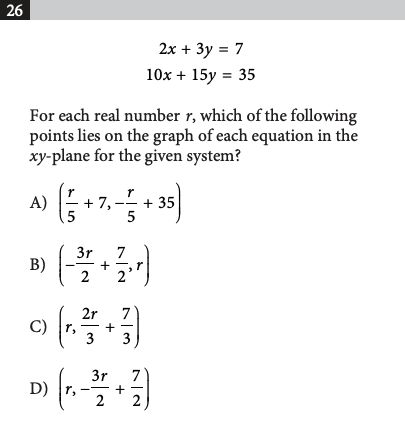
Multiple choice questions: the most common format. You will be given a statement and have 4 options, of which only one will be correct. Remember that, even though they are multiple-choice questions, mistakes are not penalized by deducting points. Here is an example published on the College Board website:
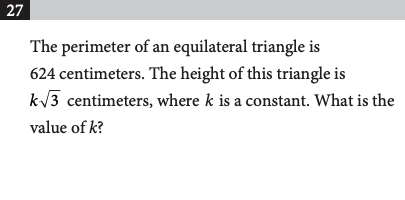
Student-produced response questions: a statement with a blank space where you must directly enter your numerical answer. There are no options to choose from. Here is an example published on the College Board website:
Call us and find out why our students have been achieving their goals since 2010.
What concepts are tested in the math section of the Digital SAT?
The math section of the Digital SAT assesses four content domains: Algebra, Advanced Mathematics, Geometry and Trigonometry, and Problem Solving and Data Analysis. Below we detail what each domain includes and show a representative example based on the official College Board materials.
Algebra
The Algebra domain tests your ability to work with linear equations, systems of equations, inequalities, and the interpretation of graphs and tables in linear contexts. It is one of the most heavily weighted domains on the exam, with a weighting that College Board places between 35% and 40% of the total math questions.
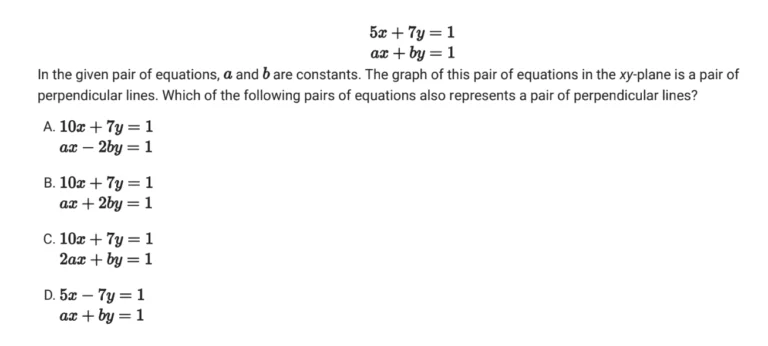
→ Want to see how to solve this type of question step by step? Jaclyn Caruana, SAT expert, explains how to solve this type of question on EPIC Prep’s YouTube channel.
Advanced Math
The Advanced Mathematics domain focuses on quadratic and higher degree equations, functions, manipulation of complex algebraic expressions, and equivalence of expressions. In EPIC Prep’s experience preparing students, this is one of the domains that requires the most work for candidates aiming for scores above 700.
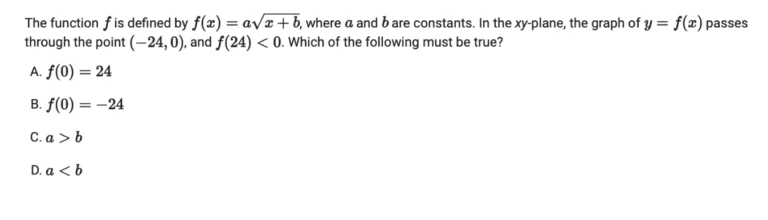
→ Jaclyn Caruana, SAT expert, shows her approach to this type of question on EPIC Prep’s YouTube channel.
Geometry and Trigonometry
The Geometry and Trigonometry domain tests areas and volumes, properties of lines, angles and triangles, circles and basic trigonometry. College Board provides a formula sheet at the beginning of the exam – but knowing when and how to apply them quickly makes all the difference in the time available.
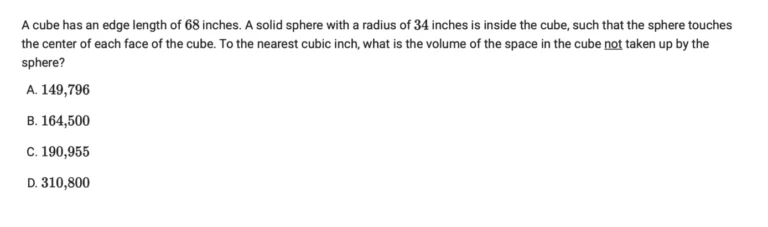
→ Jaclyn Caruana, SAT expert, explains the most efficient approach to this type of question on EPIC Prep’s YouTube channel.
Problem Solving and Data Analysis
The Problem Solving and Data Analysis domain assesses ratios, proportions, percentages, probability, and interpretation of statistical data such as mean, median, and mode. Questions in this domain are often presented in real-world contexts – scientific studies, surveys, graphs – and require you to interpret information before calculating.

→ SAT expert Jaclyn Caruana shares her strategies for percentage questions on EPIC Prep’s YouTube channel.
What is Desmos and how is it used in the math section of the Digital SAT?
Desmos is an online graphing calculator integrated directly into the Bluebook application, the official platform of the Digital SAT. It is available throughout the entire math test – in both modules and for all questions – with no need to activate or configure it.
What can you do with Desmos in the SAT?
Desmos allows you to represent functions and equations graphically, identify intersections and key points, explore the behavior of quadratic functions, and solve systems of equations visually. For many difficult questions on the SAT, strategic use of Desmos can turn a multi-step problem into an immediate visual answer.
What can’t Desmos do for you?
Desmos does not interpret the statement for you, does not select the correct strategy, and does not tell you when it is more efficient to use it versus a manual calculation. Using it wrong – for example, trying to graph when direct calculation is faster – can cost you valuable time.
Why does it matter so much in preparation?
The Digital SAT is the first standardized test of its kind to integrate an advanced graphing calculator into all math questions. Knowing how to use it strategically – not just knowing it exists – is a real advantage over candidates who have not practiced it.
Jaclyn Caruana, co-founder of EPIC Prep, is a European expert in the use of Desmos applied to SAT and author of the book Desmos SAT Hacks – a fundamental guide to this tool.
What SAT math score do you need to get into top colleges?
The SAT math score you need depends directly on the college you want to apply to. The SAT has a maximum score of 1600 points, divided into two sections of 800 each: Mathematics and Reading & Writing. You can consult the complete list of colleges that accept the SAT directly on the College Board website.
For reference, these are the usual scores at some of the most competitive universities in Europe and the USA. These figures reflect the total exam score – most universities do not set a specific minimum per section. However, for programs with a strong quantitative profile – economics, finance, engineering, architecture – a high score in the Mathematics section is decisive, even when there is no official requirement. The thresholds below are indicative: the score required to be competitive always depends on the specific program and the rest of the candidate’s file.
In Spain, IE University requires a minimum score of 1200, although competitive candidates usually submit between 1270 and 1460. Saint Louis University Madrid does not set an official minimum, but the most competitive applicants usually score between 1240 and 1270 – with grades around 630 or higher in Mathematics. ESADE puts the average of its admissions at around 1350.
In Italy, Bocconi University sets a minimum of around 1400, although this threshold may vary depending on the program and the candidate’s academic record. LUISS Guido Carli requires a minimum of 1200 for both EU and non-EU students. Università Cattolica del Sacro Cuore recommends a minimum of 560 points per section, which equals 1120 in the total exam. Politecnico di Milano accepts candidates with a minimum score of 1240. The University of Bologna recommends scores in the range of 1200-1300 or higher.
In the United States, the most selective universities – MIT, Stanford, Ivy League – place the average mathematics of their admits between 750 and 800. For the national top 50, the competitive range is between 650 and 730; for the top 100, between 580 and 660.
In the UK, Russell Group universities – Imperial College London, UCL, King’s College London, University of Edinburgh – do not publish official SAT minimums, but those admitted to competitive programs typically present total scores between 1400 and 1550+, with math above 700 in science and engineering programs.
In Germany, the SAT is accepted by a small but growing number of internationally focused institutions. As of 2026, College Board confirms 7 German universities accept the SAT — including programs at private and internationally accredited institutions. Score expectations vary significantly by program; contact EPIC Prep for guidance on your specific target.
In the Netherlands, institutions such as University College Utrecht and Amsterdam University College use the SAT as part of their admissions process for international candidates. Competitive scores typically fall in the 1300–1450 range depending on the program.
If you are not clear on what score you need for your target college, contact us – EPIC Prep helps you define your goal and design the plan to achieve it.
Call us and find out why our students have been achieving their goals since 2010.
What has changed in the math section with the Digital SAT?
The transition to digital format has introduced relevant changes in the mathematics section.
The most significant: there is no longer a part without a calculator. In the paper format, the math test was divided into two modules – one without a calculator and one with a calculator. In the Digital SAT, you can use the calculator (including Desmos) on all questions in both modules.
The time per question has also changed: in the paper format it was 75 seconds per question in the module without calculator and 87 seconds in the module with calculator. In the Digital SAT, you have 95.5 seconds per question on average – a real improvement in terms of time pressure. That does not mean, however, that it is easier. The longer time per question does not compensate for unstructured preparation: students who arrive without a clear method still encounter difficulties, regardless of the time available.
What has not changed is equally important: the four content domains remain identical to the paper format, with the same weightings. The formula sheet is still available at the start of the exam. And the bar has not been lowered – the 2022 average score was the lowest in five years, confirming that College Board has not lowered the bar.
How to prepare for the SAT Math with EPIC Prep?
EPIC Prep has been preparing students for the SAT since 2010, with 95% of students achieving their target score, 99% satisfaction and an average improvement of 225 points in a 30-hour course.
These results are supported by a specific methodology based on four pillars:
Specialized native tutors from the UK, Canada and Ireland, specifically trained in the EPIC Prep methodology. They are not generalist math teachers: they are SAT specialists.
Exclusive materials developed in-house and continuously updated based on analysis of the most recent tests, including proprietary mathematics manuals written specifically for the Digital SAT.
Hands-on approach in which each session is built around exercises from the actual test and each assignment is designed to develop exactly the skills that the SAT tests – not math in general, but SAT math.
Data analytics – through the tracking dashboard and Boost Your Prep software, the only European SAT prep software developed by a test prep company – that allows you to monitor each student’s progress at the skill level and adjust the preparation plan in real time.
EPIC Prep operates from four offices across Europe — Madrid, Barcelona, Milano, and Zürich. If you want to know in detail how we design your preparation plan, please visit our SAT course or contact us.
How to reach your target score on the SAT math section?
The SAT is a test in which participation is not enough. The competition is not against oneself but against the millions of test takers annually. Remember that the ultimate goal of a standardized test is to be able to rank all candidates so that institutions have a benchmark to compare them against. Use this mindset to prepare for the SAT math portion.
Regarding what to do for the resolution, you must separate it into:
- Preparation process prior to the exam:
- Logically structure your preparation: the SAT is not a driver’s license. It is not enough to take tests if you do not have a solid foundation in the mathematical concepts on which you will be tested. Precisely for this reason, a structured and guided preparation makes the difference. If you want to know how we design a solid and progressive study plan for the SAT mathematics, you can consult our SAT preparation coursewhere we explain in detail our methodology and work system.
- Non-stop practice: although it may seem contradictory to the previous point, it is not at all. To have a solid foundation you need to know the concepts in depth and practice them a lot. Remember that every second you beat the clock can count for a lot in your final performance.
- Memorize the most common formulas: at EPIC Prep we do not believe in memorization but in understanding. However, the fact that you know the most common formulas by heart will make you solve the exercises faster. It is not enough to be effective, you must be efficient.
- Considerations for exam day:
- Bring your own calculator: although the Bluebook has a built-in calculator, we recommend that you bring your own calculator for exam day. You will always be faster with an external calculator than with the one in the application. We leave you here the link to check if your calculator is allowed.
- Don’t stop if you don’t know an answer: Remember that each module of the math test has 22 questions. No one is forcing you to answer them in the order they appear. If you read a question and in the first 5 seconds it is clear to you that you don’t know the answer, flag it for later. Bluebook allows you to set a signal to return to it before ending the module.
- Familiarize yourself with Bluebook: complete a minimum of 2 entire exams in Bluebook to avoid usability surprises on test day.
- Decide how to manage the clock: remember that a clock appears on the screen. You can hide it or keep it. Be clear before entering the exam if, because of the way you are, it will help or hurt you to have it. If it does not generate anxiety, it is a very good tool. On the contrary, if it can affect your performance negatively, hide it and enable it from time to time.
Conclusion
The Digital SAT math section is demanding, but it is also one of the most preparable: its four domains are fixed, its structure is predictable, and its tools – including Desmos – can be mastered with systematic practice. The difference between one candidate and another is not in mathematical talent, but in the quality of preparation.
If you want to prepare with a specialized team that has been helping students across Europe reach their target SAT score since 2010, contact us. We will design together the plan you need.
We hope this article has answered your questions. If you have any questions about your preparation, please contact us and we will be happy to explain how EPIC Prep can help you achieve your goals.