
SAT Reading and Writing: A Complete Guide
The SAT Reading and Writing is one of two sections of the Digital SAT and tests advanced English language skills through 54 questions organized into four content domains, with a total time of 64 minutes spread over two adaptive modules of 27 questions each.
The Reading and Writing is a complex test designed for American high school students – and that changes everything. Don’t make the mistake of thinking that the SAT English has anything to do with the tests you’re used to. Here you won’t find a Use of English or a Listening. We tell you about its structure, the four content domains and the types of questions each one tests, how to prepare effectively, and key strategies for test day.
Table of contents
What Does the SAT Reading and Writing Test?
The SAT Reading and Writing tests advanced language skills in English – it is not a language placement test like the Cambridge tests. The test assumes that the candidate already has a high level of English and then measures the candidate’s ability to analyze texts, argue with evidence, master discourse structure and apply the grammatical conventions of standard English.
What Types of Questions Are on the SAT Reading and Writing Test?
Unlike the the math section, in the SAT Reading and Writing section you will only find multiple-choice questions. All questions consist of four options, only one of which is correct. It is important to note that on the Digital SAT incorrect answers do not penalize your score – so it is always better to answer than to leave a question blank.
What Are the Four Content Domains of the SAT Reading and Writing?
The SAT Reading and Writing is divided into four official content domains : Information and Ideas, Craft and Structure, Expression of Ideas, and Conventions of Standard English. Each domain groups a specific set of skills and carries a different weight in the final score. Knowing them in detail is not optional – it is the starting point for any serious preparation.
What Does Information and Ideas Evaluate?
Information and Ideas assesses your ability to understand, interpret and analyze texts and infographics. It is the domain with the highest relative weight in the exam and covers four types of questions: Central Ideas and Details, Inferences, and Command of Evidence – Textual and Command of Evidence – Quantitative. In the Command of Evidence Quantitative questions, tables or graphs appear – the candidate must integrate the visual data with the text to choose the correct answer.
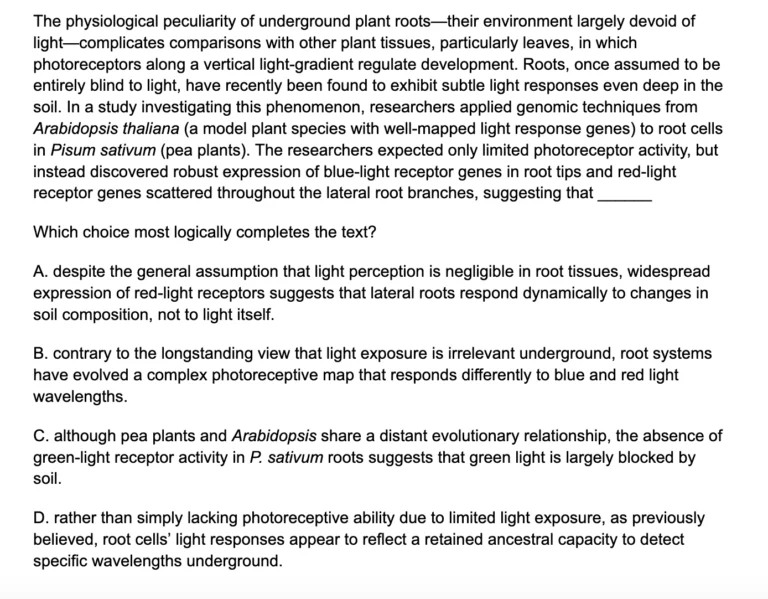
Why it is difficult for students: inference questions require drawing conclusions that are not explicit in the text, which requires a mastery of semantic nuance in English that goes beyond basic vocabulary.
→ Jaclyn Caruana, SAT expert, explains the most efficient approach to this type of question on EPIC Prep’s YouTube channel.
What Does Craft and Structure Evaluate?
Craft and Structure assesses your understanding of the inner workings of a text: how it is constructed, what rhetorical purpose it serves, and how it relates to other texts. This domain includes three types of questions: vocabulary in context (Words in Context), text structure and purpose (Text Structure and Purpose), and cross-text connections (Cross-Text Connections). Words in Context questions are the most frequently asked questions in the test – they do not ask for the standard meaning of a word, but for the precise meaning that word has in the specific context of the paragraph.

→ Want to see how to solve this type of question step by step? Jaclyn Caruana, SAT expert, explains how to answer this type of question on EPIC Prep’s YouTube channel.
What does Expression of Ideas evaluate?
Expression of Ideas assesses your ability to construct and improve texts: selecting relevant information for a specific purpose and integrating it in a cohesive way. This domain covers two types of questions: Rhetorical Synthesis and Transitions. In rhetorical synthesis questions you are given several text fragments or notes and you must combine them into a sentence that fulfills a specific communicative purpose. In the transitions questions you must choose the connecting word or expression that accurately reflects the logical relationship between two ideas.
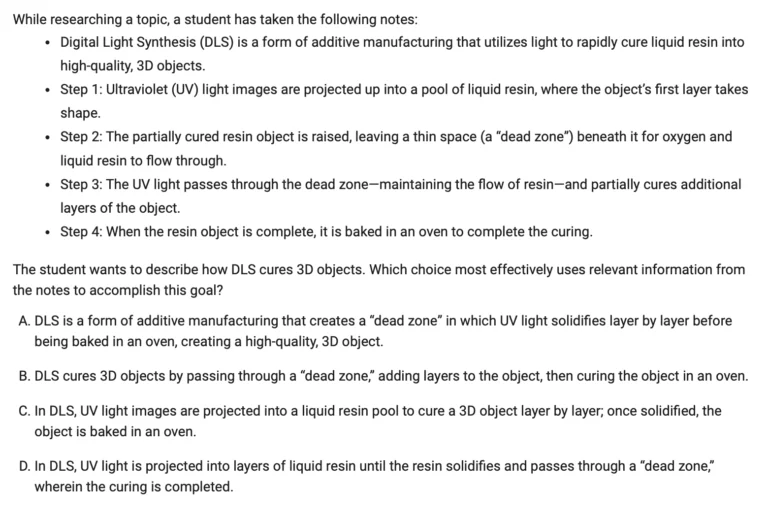
→ Jaclyn Caruana, SAT expert, shows her approach to this type of question on EPIC Prep’s YouTube channel.
What Does Conventions of Standard English Evaluate?
Conventions of Standard English assesses mastery of the grammatical and punctuation rules of formal written English. It includes two subcategories: Boundaries and Form, Structure, and Sense. Boundaries questions are especially frequent and require knowing how to accurately use periods, commas, semicolons, colons, and hyphens – including their subtle differences from each other. Form, Structure and Sense questions test verb agreement, pronouns, modifiers, and other elements of formal grammar.
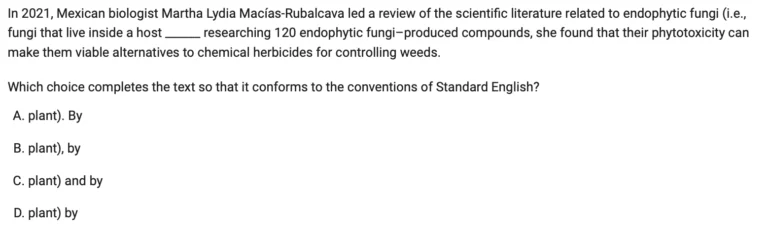
Why it is difficult for students: English punctuation has a logic of its own that does not match that of Spanish or Italian. Many students arrive with years of English and have never had to apply these rules rigorously.
→ Want to see how to answer this type of question step by step? Jaclyn Caruana, SAT expert, explains how to answer this type of question on EPIC Prep’s YouTube channel.
Call us and find out why our students have been achieving their goals since 2010.
What Has Changed On the Digital SAT Reading and Writing from the Paper SAT?
The Digital SAT has completely simplified and reorganized the Reading and Writing section. On paper there were three separate tests – Reading, Writing and Math; now the Reading and Writing is a single 54-question test in two adaptive modules. The most relevant changes are as follows:
- Number of questions: from 96 questions (52 Reading + 44 Writing) to 54 questions in total, spread over two modules of 27.
- Time per question: from an average of 62.5 seconds on paper to approximately 72 seconds on digital.
- Text structure: the five long passages of 500-700 words with 10 questions each have disappeared. Now each question has its own 100-150 word paragraph – a change that favors non-native candidates.
- Adaptive format: performance in the first module determines the difficulty of the second module, making the level of the second module a direct signal of your progress.
What Level of English is Required for the SAT Reading and Writing?
An advanced level of English is a necessary – but not sufficient – condition for a good score on the SAT Reading and Writing. The test is designed to test American high school students, so it assumes a native or very high proficiency in the language.
After preparing thousands of European students at EPIC Prep we can guarantee that a low level of English makes it impossible to achieve a competitive score, regardless of preparation time. A good level of English does not guarantee a high score, but its absence guarantees failure. Candidates arriving with a level below C1 should prioritize English improvement before starting specific SAT preparation.
One note that matters specifically for students in European countries like Spain, Italy, Germany, the Netherlands and Switzerland: the SAT tests the conventions of American academic English, which differs in meaningful ways from the English taught in European secondary curricula. International school students and bilingual students sometimes assume their English level automatically transfers to a high SAT score — it does not. The test does not reward general fluency; it rewards familiarity with very specific grammatical and rhetorical conventions. This is precisely why EPIC Prep’s preparation methodology was built for European students from the ground up, rather than adapted from American materials. Since 2010 we have worked with students from the Spanish Bachillerato, the Italian Liceo, the German Gymnasium, the Dutch VWO, and the Swiss Matura — and each curriculum creates its own set of starting advantages and gaps that an informed preparation plan must account for.

How to Prepare for the SAT Reading and Writing Effectively?
Effective SAT Reading and Writing preparation requires a structured plan in three phases: mastery of the four content domains, intensive category-based practice, and specific English punctuation work. Merely taking practice tests without prior conceptual understanding does not work – it is the most common mistake among candidates who prepare on a self-taught basis.
The SAT Reading and Writing requires more than participation. It involves competing with the hundreds of thousands of test takers each year – because the purpose of a standardized test is to rank all candidates and provide colleges with a common benchmark. Adopt that mindset from the first day of preparation.
The process has three pillars:
First, master the four domains before doing timed practice: understand what each question type assesses and how the SAT response logic works.
Second, practice by category until the resolution is automatic – every fraction of a second gained on the clock can make a significant difference in your final result.
Third, work specifically on English punctuation: the differences between period, semicolon, colon and dash are frequently asked questions and are prepared with surgical precision. The same applies to transition words – it is not enough to know them, you must master the exact logical difference between each.
If you would like to learn how we design each student’s study plan at EPIC, you can check out our SAT prep course page. SAT preparation course.
For students preparing in European countries like Spain, Italy, Germany, the Netherlands, or Switzerland, there is a fourth consideration that students preparing in the United States do not face: exam date availability. SAT test centers in Europe offer fewer dates per year than those in the US, and popular centers fill quickly. In Spain, test centers operate in Madrid and Barcelona; in Italy, primarily in Milan and Rome; in Switzerland from Zürich; in Germany and the Netherlands, availability varies by city and sitting. Planning your preparation timeline around available European test dates — and registering early — is not optional. It directly determines how much preparation time you have and when your scores will be available for university applications.
At EPIC we use Boost Your Prep, the only SAT prep software developed by a European company, with over 3,000 exercises categorized by content domain and a personalized progress dashboard. This allows us to identify precisely which categories each student needs to work on instead of generic practice.
If your goal is admission to a US university, or to an English-taught program at a European institution — such as Bocconi in Milan, LUISS in Rome, the University of Amsterdam, or one of the German universities that accept the SAT — the Reading and Writing score carries significant weight. Most competitive programs at these institutions look for a combined SAT score of 1300 or above, which typically requires a Reading and Writing score in the range of 650 or above. Understanding the score you are aiming for before you begin preparation is essential, because it determines how much time you need and which content domains deserve the most focus in your study plan.
What Strategies Can I Use on the SAT Reading and Writing on Test Day?
On the day of the exam, time management strategy and order of resolution can make the difference between an average score and a high score.
Each module has 27 questions and it is not mandatory to solve them in order. If in the first 5 seconds of reading a question you don’t find immediately approachable, mark it with the Bluebook review tool and move on to the next one – the time you waste getting stuck on a difficult question is the same time you could use to secure three easier answers.
Before the exam, decide whether to leave the timer visible or not: for some candidates it is a useful stimulus, for others it generates anxiety that impairs performance. The right decision depends on your profile. Practice at least one full exam on the Bluebook before the actual day – the digital environment has peculiarities that you cannot discover for the first time in the official exam.
We hope this article has answered your questions. If you have any questions about your preparation, please contact us and we will be happy to explain how EPIC Prep can help you achieve your goals.